Hard Drive Reliability Ranked: WD Fails at Half Seagate's Rate
A peer-reviewed analysis of 443,000 Backblaze drives found WD fails at 52% of Seagate's rate. Toshiba failure rates quadruple after 5 years. What NAS buyers need to know.
Economists Christoph Siemroth and Yeomyung Park published a peer-reviewed analysis of 443,156 Backblaze hard drives in 2026, covering 1.66 million drive-years of operational data from 2013 through Q2 2025. The headline result: when controlling for drive age, capacity, form factor, and operating temperature, Seagate and Toshiba drives fail at roughly double the rate of WD and HGST.
The failure rates by brand
HGST ranks most reliable, failing at just 41% of Seagate's rate. WD sits at 52%. Toshiba ranks last at 107%, marginally worse than Seagate. HGST is no longer available to buy: WD acquired it in 2012 and wound down the product line.
Toshiba's age-related pattern is the sharpest finding. Failure rates more than quadruple once Toshiba drives pass 60 months in service, rising to 5-6 failures per 1,000 drives per month at the 50-100 month mark. The other three brands hold at or below 2.5 per 1,000 per month across the same age range. No other manufacturer in the dataset shows a comparable reliability cliff at any age.
What NAS buyers should take from this
For a NAS drive running 24/7, the age curve matters as much as the baseline failure rate. A drive at continuous use for 5 years hits exactly the 60-month threshold where Toshiba's reliability degrades sharply.
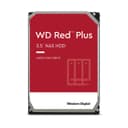
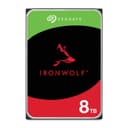
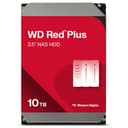
At 8TB, the WD Red Plus 8TB undercuts the Seagate IronWolf 8TB on price while carrying the same 3-year warranty. With equivalent NAS-specific firmware, this study gives WD a concrete statistical edge for long-term builds at that capacity. The Seagate IronWolf 4TB and WD Red Plus 4TB remain NAS-rated, under-warranty picks at the smaller capacity — check current pricing on both before deciding, since the gap between them varies. Seagate's overall failure rate is not alarming in absolute terms, so it's still a reasonable pick for a 2-bay NAS that rotates drives every 3-4 years. But for a 4+ bay NAS expected to run 5+ years without drive replacement, WD's track record in this 443,000-drive dataset is the stronger argument.
Frequently Asked Questions
Are WD drives more reliable than Seagate for a NAS?
Based on a peer-reviewed study of 443,000 Backblaze drives spanning 1.66 million drive-years, WD drives fail at 52% of Seagate's rate when controlling for age, capacity, and temperature. That's roughly half the failure rate. The data covers actual operational drives from 2013 through Q2 2025, making it the largest independent analysis of HDD reliability published to date.
Do Toshiba hard drives fail faster as they age?
Yes. The study found Toshiba failure rates more than quadruple once drives exceed 60 months in service, climbing to 5-6 failures per 1,000 drives per month at 50-100 months. Seagate, WD, and HGST all stay at or below 2.5 per 1,000 per month across the same age range. No other manufacturer in the 443,000-drive dataset shows a comparable reliability cliff at any age.
Should I still use Seagate IronWolf drives in a NAS?
Seagate IronWolf drives are NAS-rated, purpose-built for 24/7 operation, and carry a 3-year warranty. Their failure rate is roughly twice WD's in this dataset, but not alarming in absolute terms. For a 2-bay NAS with drives that rotate every 3-4 years, Seagate is a reasonable pick. For a 4+ bay NAS expected to run for 5+ years without replacement, WD's reliability profile is the more defensible choice.