How Many Joules Do You Need in a Surge Protector?
Joule ratings explained: how many joules a surge protector needs for phones, a home office, a TV or a gaming PC, what clamping voltage means, and when to replace one.
A surge protector's joule rating tells you how much energy it can absorb before its protection wears out. It is the number printed biggest on the box, and it is the easiest way to match a surge protector to what you plug into it. Here is how many joules you actually need, and the two other things worth checking before you buy.
How many joules for what you are protecting
| What you plug in | Joules to look for | Example from our rankings |
|---|---|---|
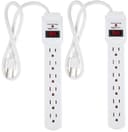
| Lamps, phone chargers, small appliances | Under 1,000 | Amazon Basics 2-pack (200J) |
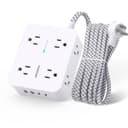
| Laptop, printer, router, home office | 1,000 to 2,000 | HANYCONY 8-outlet (1,080J) |
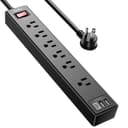
| TV, desktop PC and monitors | 1,500 to 2,500 | Yintar 6-outlet (1,680J) |
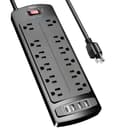
| Gaming PC, console, home theatre | 2,000 or more | ALESTOR 12-outlet (2,700J) |
A surge protector does not shield your devices forever. Every surge, including the small everyday ones you never notice, uses up part of its capacity. More joules means more headroom and a longer useful life, which is why it makes sense to buy above the minimum for expensive equipment.
Clamping voltage: the other number that matters
Clamping voltage, listed as the Voltage Protection Rating (VPR), is the voltage at which the protector starts diverting a surge. Lower is better. The lowest common rating is 330V, with 400V and 500V also widely used. A high joule rating with a high clamping voltage lets more of a spike reach your devices before protection kicks in. Not every listing shows it, so check the packaging or the manufacturer's spec sheet.
Make sure it is actually a surge protector
Power strips and surge protectors often look identical. A plain power strip only adds outlets and offers no protection at all. Look for a stated joule rating and a UL 1449 listing, the US safety standard for surge protective devices. Every product in our surge protector rankings lists a joule rating; we left out listings that did not state one.
Pick the right shape for the job
- Behind a desk or TV: a flat-plug strip with a long cord, such as the SUPERDANNY 10ft, sits flush against the wall.
- Full gaming or desk setup: twelve outlets and 2,000+ joules, such as the ALESTOR or the Anker 12-outlet (2,100J), which adds a USB-C port.
- Nightstand, kitchen or dorm: a wall-mounted outlet extender like the QINLIANF (1,680J) needs no cord at all.
What a surge protector will not do
It will not keep anything running during a power cut; for that you need a UPS (uninterruptible power supply), which many include surge protection as well. It also cannot stop a direct lightning strike to your home. Plug it straight into a wall outlet rather than into another power strip or extension cord, since manufacturers warn that daisy-chaining can overload the circuit. Replace it after a major surge or when its "protected" light goes out.
Frequently Asked Questions
How many joules do I need for a gaming PC?
Aim for 2,000 joules or more for a gaming PC with monitors and a console. That is the range most commonly recommended for expensive electronics, and it leaves headroom because a surge protector's capacity wears down with every surge it absorbs.
Is a higher joule rating always better?
Higher joules means the protector can absorb more energy before it wears out, so it lasts longer and handles bigger surges. It is not the only number that matters: a lower clamping voltage (for example 330V rather than 500V) means it starts protecting sooner, and a UL 1449 listing shows it has been tested to the safety standard.
What is the difference between a power strip and a surge protector?
A power strip only adds outlets. A surge protector adds outlets and diverts voltage spikes away from your devices. Many products look identical, so check for a joule rating and a UL 1449 listing on the packaging or listing before assuming a strip offers protection.
Do surge protectors wear out?
Yes. The components that absorb surges degrade a little with each one, and a large surge can use up most of their capacity at once. Many models have a 'protected' indicator light that goes out when protection is gone, even though the outlets may still supply power. Replace a protector after a major surge or when that light goes out.